Introduction
Ghee has something eternal, something eternal. It has been living with the Indian kitchens over centuries, with the tales about it being a source of nourishment and purity. However this is not always the case in the fast-paced contemporary world, as in most cases, fear of adulteration tends to follow its beauty. The shelves appear to be filled, the names are being breathed out by the labels, and brands are roaring of purity more than ever. However, the real question still hangs in the air: how to identify pure ghee without getting fooled?
Due to the fact that ghee does not appear different on the outside, people tend to be confused. The shine is even deceitful, the color can deceive the eyes. As such basic home tests become a comfort. They assist in the comprehension of what is real, and what is mixed. It is not only tastier, however, but can also aid health using healthy fats, antioxidants, and a natural calming aroma.
Meanwhile, fake ghee is tainted with cheap fillers that harm digestion and nutritional value. Therefore, learning how to check purity of ghee at home becomes not just a choice, but a small act of self‑care. This guide softens the conclusion and introduces easy, simple, everyday solutions that work.
Common Adulterants Found in Ghee
The sad truth is that ghee is mixed with most of the cheap fats. Traders usually blend vegetable oils, refined oils and vanaspati in order to increase quantity. These additives however alter the nature of ghee altogether. Another type of most common adulterant is vanaspati, which contains trans fats, which may over time influence the heart health.
In some cases, animal body fats are even added in order to imitate texture. Not only does this make purity less, but it kills the nutritional value, too. In the meantime, oils such as palm and coconut can be used since they melt the same. Even there their smell and actions in the heat tell the truth. Knowledge of adulterants will, therefore, aid in their recognition at a faster rate.
So, knowing these differences helps in understanding how to identify pure ghee in daily life without any confusion.
Signs of Pure Ghee: Color, Aroma & Texture
Ghee has its own personality. It has a light golden glow, a soothing aroma and a creamy grainy texture when it is pure. These qualities are as a result of gradual butter heating that affects separation of milk solids on its own. When the shade appears either too white or too vivid it usually gives indications of the additions of oils.
The smell of pure ghee is warm and comfortable. It smells like spinning caramel, almost nutty. However, contaminated ghee tends to be smelled of artificial or bland. In the meantime, there is also text talking. Pure ghee becomes semi-solid during winter and becomes rapidly liquid with a thin fine consistency during summer. It doesn’t feel sticky or waxy.
Therefore, the initial indication is the sight of color, smell, and feel. Nevertheless, physical symptoms are insufficient. Simple home tests for desi ghee in that regard are much easier to understand and decode.
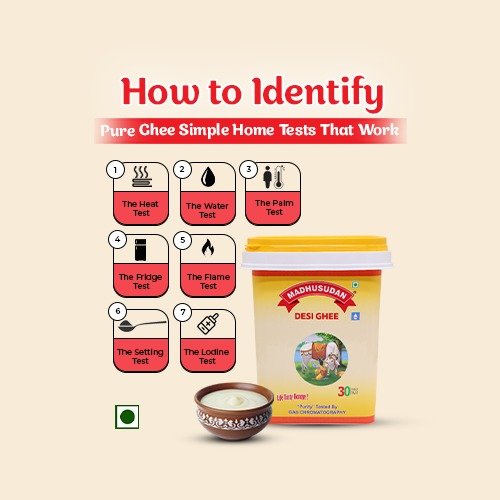
Simple Home Tests to Identify Pure Ghee
These tests are safe, non-toxic, and based on basic chemistry. Most people already have what they need in their kitchens, making it easy to learn how to check purity of ghee at home without stress.
The Heat Test
On a low burner heat a little spoon of ghee. Pure ghee is able to melt smoothly and looks clear or transparent. Meanwhile, adulterated ghee can either form white layers or leave residue. It is among the most easy methods of early detection of adulteration.
The Water Test
Added to a glass of warm water is one spoon of ghee. The pure ghee is poured in smooth lumps at the bottom. Meanwhile, the fake Ghee may either float or have oil spots on the surface. As a result, this test gives a quick idea about purity, especially when suspicious mixing feels likely.
The Iodine Test
To a small spoon of melted ghee add two drops of iodine. When the color turns blue, there is the presence of starch. Unless otherwise, the ghee does not fake. Iodine checks can also be employed to identify the pattern of adulteration by FSSAI.
The Palm Test (Body Heat Test)
Put a small portion of ghee on the palm. The melted ghee is pure and it melts in seconds. The reason why the fake ghee is solid is that mixed fats have low melting points. This purity is exposed immediately with this light, fast test.
The Settling Test
Allow a spoon of melted ghee to rest with time. Pure ghee is layered out in a clear and uniform layer. Adulterated ghee can be cloudy, stratified or sedimented. The consistency is maintained even during cooling.
The Fridge Test
Set a small bowl of ghee into the refrigerator and leave it for one hour. Ghee goes solid in pure form on a smooth surface. Mixed ghee layers occur due to the fact that oils do not freeze at the same temperature. This test is capable of reliably identifying the presence of adulteration which is oil-based.
The Flame Test
Put a piece of cotton wick in ghee and attempt to light it. The burnt pure ghee flame equally. The ghee adulteration could crackle, or give weird smells because of mixed oils. This historical test can be very instructive.
Gas Chromatography (GC) Method- Advanced Lab Test of Purity
Some brands also use modern lab tests to check purity. Madhusudan World uses a method called Gas Chromatography (GC) to make sure their ghee has no mixed oils. This test works by breaking the ghee into tiny vapors and checking their natural pattern. Pure ghee shows a clean pattern. However, if any cheap oil or vanaspati is mixed, the pattern changes. As a result, GC testing easily finds even very small adulterants. This method helps brands deliver safe and truly pure ghee.
How to Identify Pure Ghee
Understanding how to identify pure ghee requires a combination of the senses. Observing aroma, color, flow, and behavior under heat helps. Take the scent, appearance, its movement, its behavior at high temperature. Purity can be determined by simple home tests. Believe in brands that are openly available. Focus on sourcing, processing and certifications. By a steady dish by dish method we can find ghee which is pure.
Difference Between Pure and Adulterated Ghee
Pure ghee helps in digestion, immunity and general nourishment. It has good fatty acids and antioxidants which a study conducted in the National Dairy Research Institute has indicated to be helpful in moderation.
Impure ghee carries with it toxic additives. It is tasteless, is not melted smooth and has no smell. Its healthiness becomes dismal. On the contrary, pure ghee is light and natural in the stomach which boosts food. The consideration of pure ghee will be necessary to be healthy and to taste.
How to Choose Authentic Ghee in the Market
Always make sure to buy the right ghee at all times. True brands tend to include the breed of cows, sources of milk, and ways of preparation. Low prices will normally indicate that it is adulterated or fake. Search for certifications such as AGMARK. Color and aroma can be viewed, where possible, by means of transparent packaging. And this is exactly why you can fully trust Madhusudan World, because we put purity and quality above everything else.
Benefits of Using Pure Ghee Over Fake Ghee
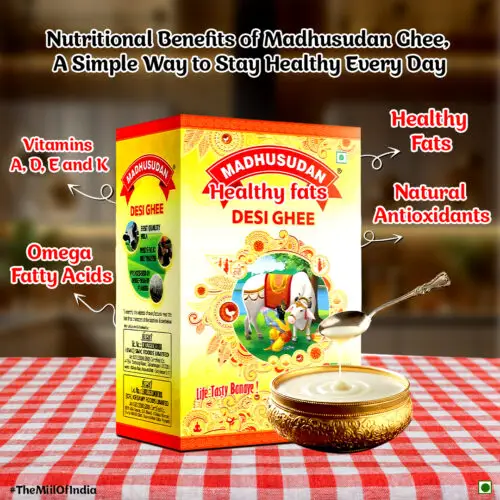
Ghee which is pure contains natural vitamins A, D, E, and K that aid in hormonal balance, immune enhancement, and bone health. It also enhances the state of digestion, skin hydration and constant energy source. The Ayurveda suggests that the pure ghee should be used in reasonably proportionate amounts daily in cooking.
Counterfeit ghee may have trans fats which damage the health of the heart and liver in the long run. The use of pure ghee is a kind of gift to the body.
Conclusion
Pure ghee brings a generation gap together. It enriches the body, aids in the digestion process and enhances taste naturally. But the contemporary marketplace is usually a warp of truth and fillers. Learning how to identify pure ghee becomes essential. Basic house tests display an understanding. The confidence is seen in observing aroma, color, texture, and behavior of melting.
Since purity is definite and comes, health is natural. With this knowledge, it is easier and more significant to use pure ghee with each passing day.
(FAQ)
1. How to identify pure ghee at home easily?
Purity is realized fast by passing simple tests, such as heating, palm test, and fridge test.
2. How to check purity of ghee at home without chemicals?
Apply the heat test, water test and palm test. These need no chemicals.
3. Why does fake ghee smell different?
Vanaspati and mixed oils do not have the natural aroma that pure ghee has.
4. Is cow ghee always pure?
No, even cow-gee may be adulterated. Testing is still important.